
It Takes Two to Talk: A Speech Therapist's Guide to Communicating With Someone Who Stutters
TL;DR
Wondering how to talk to someone who stutters? Short version: it takes two to talk. The person who stutters does their part - self-advocates (names it, sets expectations, guides you) AND considers the listener (who they are, what they need, how much time they have). The listener does theirs - looks at them, doesn't finish their sentences, holds space, focuses on the message. Both halves matter. Below: stories from the NFL draft and a sales call, plus practical tips for both sides.
I've spent millions of minutes helping people who stutter say what they really want to say.
Here's what most people miss.
Communication is not a solo act.
The person who stutters can do everything right. For all the work above the surface - the speech mechanics. For all the work beneath the surface - the attitudes, beliefs, and how they relate to their stuttering and to themselves. Showing up with confidence and clarity.
Still - if the person on the other side of the conversation isn't doing THEIR part, the whole thing breaks down.
It takes two to talk.
But here's the OTHER half people miss. The person who stutters has work to do beyond their own speech. They need to consider the listener too. Who is this person? What do they need? How much time do they have? What are they actually trying to get from this conversation?
Too often, people who stutter spend ALL their energy on their own speech experience - and none on the person across from them.
This is not a knock. Carrying a stutter into every conversation is exhausting work. But the truth stands: when you fail to consider the OTHER person, you're going to be a failing communicator. Doesn't matter how fluent you are. Doesn't matter how much you stutter.
When you DO consider them? Communication becomes the superglue of connection.
That's the key to winning communication.
The KC Concepcion Moment
KC Concepcion just got drafted by the Cleveland Browns with the 24th pick in the first round of the 2026 NFL Draft. The 2025 Paul Hornung Award winner from Texas A&M.
He also stutters. Openly. A week before the draft, KC wrote A Letter to NFL GM’s in The Players' Tribune.
"My stutter is part of who I am, but it's not all of who I am."
KC wrote about how every pre-draft interview started and ended with the stutter. The stutter. The stutter. The stutter.
KC Concepcion with Rich Eisen | Full Interview
Then Rich Eisen sat down with him.
For 8 full minutes, nobody mentioned the stutter.
That wasn't avoidance. KC showed up ready for the interview. And Rich knew exactly what he was doing.
Here are 4 moves Rich made that anyone can replicate:
1. He spoke man-to-man. Found common ground. Built human connection first. No clipboard energy. No interviewer voice.
2. He asked about KC the PERSON, not just the player. What KC cares about. Who he is. Where he comes from. The whole human.
3. He gave specific compliments. Nothing condescending. Not "you're so brave." Not "I admire what you're doing." Real, specific recognition for real, specific things.
4. He let KC show up first. Eight whole minutes of conversation before the word stutter came up. Time for KC to be himself before being filtered through a single trait.
This interview was a masterclass.
Why did it work? Because Rich held up his end. KC held up his. They both showed up and made this a winning conversation!
The Sales Call That Hit Me Hard
A friend texted me last week. He works in business development and sales. Doesn't stutter. We used to share an office, so he picked up a lot about stuttering just by being around me.
He was on a sales call. The other guy stuttered. Within the first minute, the guy disclosed it openly.
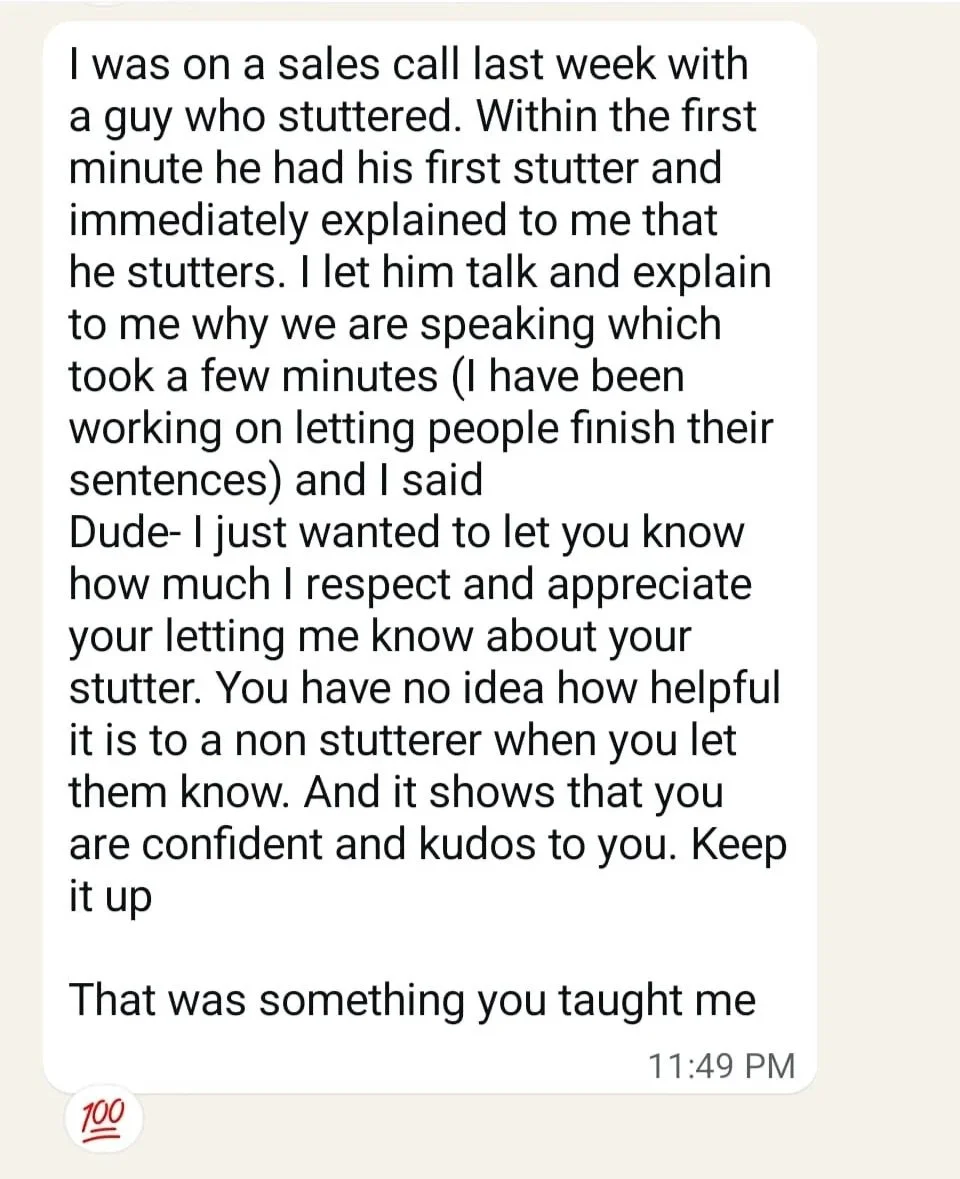
My friend sent me this text::
"I let him talk. I let him finish his sentences. (I've been working on that.) Then I told him: 'Dude, I just wanted to let you know how much I respect and appreciate you letting me know about your stutter. You have no idea how helpful that is to a non-stutterer when you let them know. And it shows confidence. Kudos to you. Keep it up.'"
He signed off: "That was something you taught me."
I sat with that for a long time.
That's another anecdote of how it takes two to talk.
The guy on the call did his part. He self-advocated. He was open. He was on-point. He showed up. And my friend did his part. He held space. He listened. He acknowledged. He didn't try to fix anything.
Real connection. Real results. Taking care of business.
“You have no idea how helpful that is to a non-stutterer when you let them know. And it shows confidence. Kudos to you.”
How to Talk to Someone Who Stutters
Most people freeze when they encounter stuttering. They don't know what to do, where to look, whether to mention it. Both sides of the conversation have a part to play. Below: what to do if you stutter, what to do beyond the stutter, and what to do if you're the listener.
If You Stutter: The Power of Self-Advocacy
Whether you call it self-advocacy, being open, disclosure, or advertising, one thing is clear: it works. Research shows listeners judge people who stutter MORE favorably when they self-advocate. People who are open about their stutter get rated as outgoing, confident, and friendly.
That's the upside.
Self-advocacy is the antidote to misconception and misperception.
Misconceptions are faulty information about stuttering. The antidote is giving good information.
Misperceptions are faulty interpretations about you. The antidote is being clear about how you want to be treated.
The general rule: don't be self-deprecating or apologetic. Advocate for yourself. When you show people your ease and confidence, you'll see the same back.
Here's how to do it. Try these three steps:
1. Acknowledge it. Name it.
You don't need a speech. Just name it.
"You may hear me hesitate on some words."
"Yeah, I had an extra dose of cadence in my speech."
"I invest more in my words than most people."
2. Set expectations.
For them and for you.
"You may or may not hear it come up."
"It's like a hiccup. It's not a brain freeze or a confidence thing."
"Sometimes I get it when I get a burst of exciting ideas."
3. Guide your listener.
Tell them what you want them to do.
"If and when it happens, just hang in there. I'll get it out."
"If it happens, feel free to ask any questions."
"If you know exactly what I'm saying, feel free to fill in. If not, let me finish what I have to say."
Hear the difference between "You might notice I repeat some sounds and words. Hang in there and it will be worth it" and "Yeah I stutter, please bear with me, I think I'll get through it"?
Same idea. Very different feeling. The second one invites pity. The first one invites partnership.
Name the elephant. Deflate the elephant. This can melt the tension and facilitate the connection!
Then Go Beyond Your Stutter
Self-advocacy is a step - not the finish line.
Once you've named it and guided your listener, the work isn't over. You also have to be a good communicator. Same as anyone else.
That means:
Read the room. Is this a quick exchange or a long conversation? Match your energy.
Know your audience. What do they need from this conversation? What's their context?
Consider their time. A 5-minute window is not the same as a 30-minute meeting.
Listen back. Communication isn't one-way. The other person has things to say too.
Too often, people who stutter spend ALL their energy on managing their speech and forget there's another person in the room. Someone with their own context, their own clock, their own goals.
This isn't about shaming anyone. Stuttering is hard work. But great communication is mutual. You have to do your part beyond your stutter.
Think about KC again. He didn't just walk into his pre-draft interviews and self-advocate. He wrote a whole letter to NFL GMs that read the room. He knew they wanted to know who he is as a player AND a person. He gave them both. That's reading the room. That's knowing your audience. That's why his letter worked.
If You're the Listener: How to Do Your Part
Now the other half. Seven practical tips.
1. Look at them. Not at the floor. Not at your phone. Not at the wall behind their head. Just look at them. Like you would with anyone else.
2. Don't finish their sentences. It feels helpful. It's not. You're cutting them off mid-thought. You're saying: I can't wait. You're saying: your words are mine to take. Let them finish. They will.
3. Stay in your normal pace. Don't slow your speech down. Don't talk louder. Don't simplify your words. They're not a child. They're an adult who got stuck on a sound.
4. Hold space. If there's a long pause, let it sit. Don't rush to fill it. Some of the most important things people say come right after a pause.
5. If they self-advocate, acknowledge it simply. You don't need a speech. "Thanks for telling me, I appreciate that" is plenty. Then move on. Don't make it the whole conversation.
6. Stop trying to "help" with their speech. Don't say "take a deep breath." Don't say "slow down." Don't say "you can do it." They're already doing it. Let them.
7. Focus on what they're SAYING, not how they're saying it. This is the whole thing. Listen for the message. The meaning. The person. Not the disfluency. The disfluency is just the wrapper.
What This Means for Parents, Teachers, and Managers
If you're a parent of a kid who stutters, your job is not to fix the stutter. Your job is to be the safest pair of ears in your child's life. The place where they get to be themselves. Where they don't feel rushed. Where their words land.
If you're a teacher, call on them like you call on anyone else. Don't skip them. Don't single them out. Let them participate in the rhythm of the class.
If you're a manager or a colleague, don't avoid one-on-ones with someone who stutters. Don't put them in written communication only "to make it easier." Easier for who? Let them lead meetings. Let them present. They've already done the work. You just need to hold up your end.
KC Concepcion’s Message to Any Kid Reading This
“So, to any kid out there who is carrying something heavy right now — a stutter, something that makes you feel different, anything that’s ever made someone look at you sideways … just know this: My success … it is your success, too. I want you to come along on this journey with me. Because you and me? We’re not weird. There is nothing wrong with us. Whatever makes you different — that’s not the thing holding you back. That’s your thing. Own it. Be you, fully. Without apology.
I had to grow up fast and fight hard to get here, for sure. And I’d do it all again. You can do the same thing and reach whatever goals you set for yourself. I’m living proof of that. ”
The Truth About Communication
I tell my clients all the time. There's no "right way" to talk.
Clarify the message. Deliver it with heart. Sheet music played with feeling.
Successful communication is taking the idea or feeling in MY head and heart, and transplanting it in YOUR head and heart with success.
That's it.
When you stutter, you can still do that. Beautifully.
When you don't stutter, your job is to make sure the message can land. Be a good receiver. Be the kind of listener who makes the room safe.
KC Concepcion is going to play in the NFL with a stutter. Rich Eisen is going to interview people for decades. My friend is going to close more deals. The guy on the sales call is going to keep selling.
All of them are communicating. All of them are succeeding.
Fluency was never the point.
Connection was.
And it takes two to make that happen.
🎧 Listen to real conversations on our podcast, Transcending X
Frequently Asked Questions
See answers to the questions we get asked most often. Scan for what you need.
How do I respond when someone tells me they stutter?
Acknowledge it simply and move on. "Thanks for letting me know, I appreciate it" is plenty. Then keep the conversation going like you would with anyone else. The worst move is making it the whole interaction. They didn't disclose to start a conversation about stuttering. They disclosed so the rest of the conversation can flow.
Should I finish someone's sentences if they're stuck on a word?
No. It feels helpful in the moment. It isn't. You're saying "I can't wait for you" and "your words are mine to take." If they explicitly invite you to fill in ("if you know what I'm trying to say, feel free to jump in") then it's fair game. Otherwise: hold space. Let them finish. They will.
Is it rude to mention that someone stutters?
It depends on how. If they've already named it themselves, you can acknowledge it warmly and move on. If they haven't named it, don't bring it up first. Don't ask if they're nervous. Don't suggest they "take a breath." Just keep listening. The person decides when and how their stutter becomes part of the conversation.
How can I support my child who stutters?
Be the safest pair of ears in their life. Don't rush them. Don't finish their sentences. Don't tell them to "slow down" or "think before you speak." Look at them when they're talking. Show them that what they're saying matters more than how it's coming out. If you want professional support, find a clinician who treats both what's above the surface (speech mechanics, skills for tough moments) AND what's beneath the surface (how your kid feels about their speech and about themselves). Both matter. Treating one and not the other is a mistake.
What's the best thing to say to someone who stutters?
Whatever you'd say to anyone else. Treat them like a full adult. Talk about the work. Talk about the weekend. Talk about the project. Don't lead with their stutter. Don't avoid eye contact. The biggest "kindness" most people can offer is just normalcy.
Does stuttering go away?
For some kids, yes. About 75% of preschoolers who stutter recover, often within a few years. For others, it persists into adulthood. That doesn't mean adults who stutter are stuck. With the right support - both above the surface (skills) and beneath the surface (how they relate to their stuttering and themselves) - people who stutter can communicate powerfully, successfully, and on their own terms. KC Concepcion is one of many living examples.
If you or someone you love stutters and you want to work with a clinician who's spent millions of minutes inside conversations like these, that's what we do at Schneider Speech. Reach out anytime.
And KC, if you're reading this: I'm rooting for you. The kids who stutter are watching. They see one of their own going to the NFL. That's everything. Come on the podcast. Transcending X is waiting for you.
More Public Figures Speaking Openly About Stuttering:
👉 Want to Go Deeper?
We work with people who stutter - and those who support them - to build communication skills, confidence and courage.
Learn more about how we work.
See more blog posts like this
Finding My Voice Through Creativity: A Journey with Stuttering - Naomi Zauderer
From Rock Bottom to the White House - Billy's Speech Triumph
Sacred Encounters - Podcast Episode with Modi and Arthur Luxenberg (And Here’s Modi #106)
I Fought to Find My Voice. Now I Use it To Empower Others by Andrew Carlins
Alchemist’s Secret by Andrew Carlins
Stuttering Transformation by Devora
Listen to our TranscendingX Podcast